Series F · Fresh air + heat recovery
Series F: fresh-air dehumidifier with heat recovery
One concealed unit brings in filtered outdoor air, exhausts stale air, recovers energy from the exhaust stream and dehumidifies the supply. For sealed villas and apartments where windows stay shut and the AC cannot dry the air.
Price on request
Installed price after a site survey.

System details
Two airstreams, one unit
Outdoor air is filtered, passes the heat-recovery core where it gives up heat to the outgoing exhaust, is dried on the cooling coil and supplied to the rooms. Stale indoor air is extracted and exhausted outside. The home receives dry, filtered fresh air at a slight positive pressure, instead of humid air leaking in through gaps.
This is the system for double-glazed homes that trap moisture from showers, cooking and laundry and have no clean way to ventilate.
- Fresh-air intake, exhaust, supply and extract on dedicated ducts
- Energy recovered from the exhaust before it leaves
- Dehumidification of the supply air on a cooling coil
- Plumbed condensate drain, humidistat control
Outdoor air is filtered before it is dried
The pre-filter takes the sand and dust out of the intake air, the fine-filter stage the fine particles and pollen, the carbon stage the traffic odours. Grades and intervals are on the datasheet; the intake filter sees more dust than a recirculating unit's and is checked more often.
- Pre-filter: washable
- Fine-filter stage: datasheet interval
- Activated carbon: datasheet interval
Fresh air with or without drying
In the main mode the unit ventilates and dehumidifies together. When the outdoor air is dry enough, the coil rests and the unit ventilates only. A boost setting raises the fresh-air rate for a full house or after cooking.
- Fresh air with dehumidification
- Fresh air only (ventilation)
- Boost
Setpoint, fan speed, filter status
The wall controller sets the humidity target and the fresh-air rate and shows when filters are due. One controller per unit.
- Humidity setpoint and fan speed on the panel
Where it goes
Where the unit sits and how the air moves
Only the grilles and the wall controller stay visible. The unit, its ducts and its drain are above the ceiling.
- 01
Near an outside wall or riser
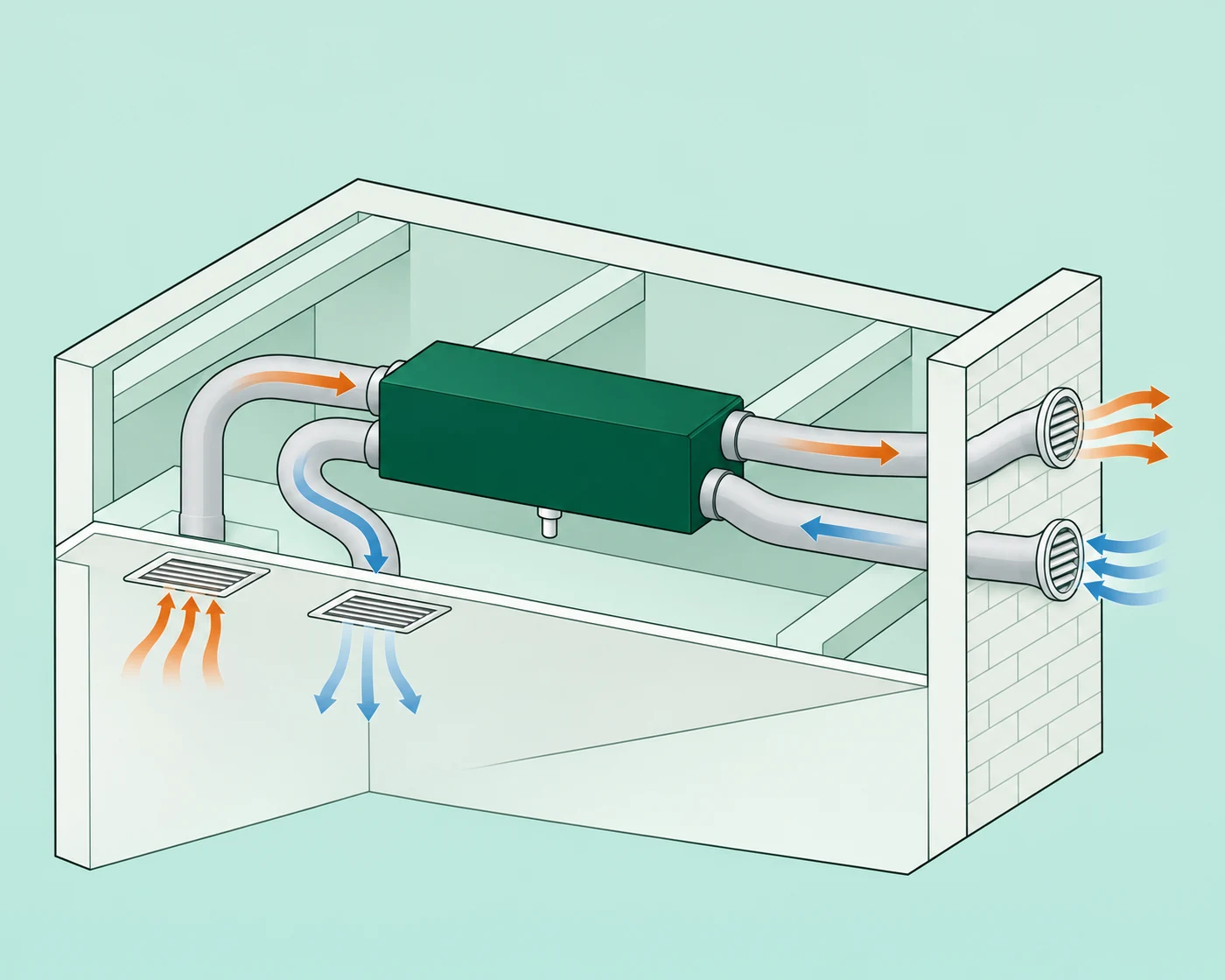
The unit needs two outdoor connections (intake and exhaust) and two indoor ones (supply and extract), so it sits in the ceiling void close to an external wall or a service riser. Ceiling height: on the datasheet.
- 02
Supply and extract grilles
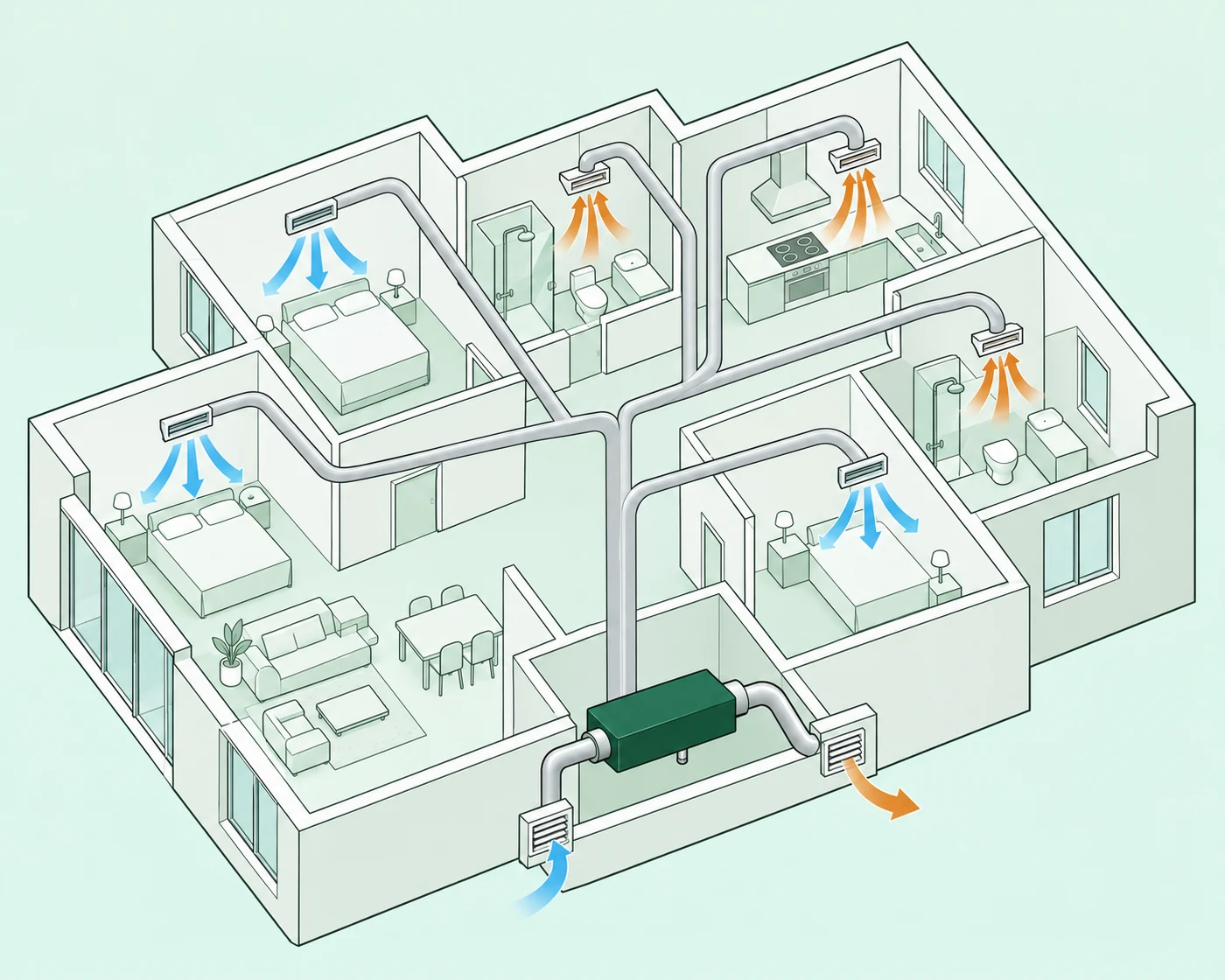
Dry, filtered fresh air is supplied to bedrooms and living rooms; stale air is extracted from kitchens, bathrooms and corridors. The installer balances the two so the home stays at a slight positive pressure.
- 03
Drain and controls
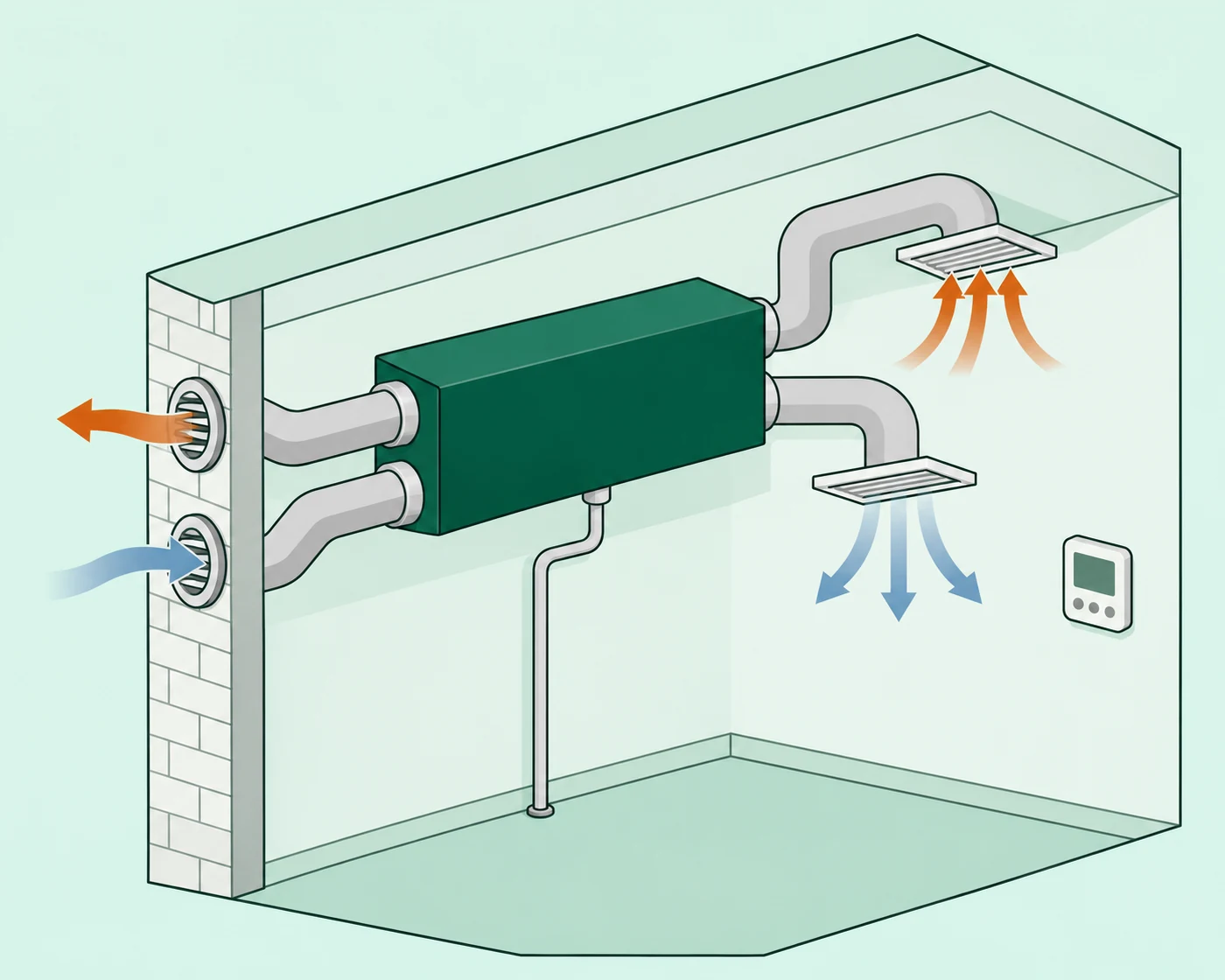
Condensate from the coil goes to a drain by gravity or by pump. The intake and exhaust terminals on the facade are weather-protected and kept apart so exhaust is not drawn back in.
Technical data
Published figures only
Every row below comes from the manufacturer datasheet at its stated test conditions. A row without a published figure is marked, never guessed. Competitor pages in the UAE list contradictory filtration specs; ours cite the sheet.
The manufacturer datasheet for this family has not been published yet, so no figure is shown here: capacity, airflow, sound level and power are quoted per project after the survey, and the table fills in the day the datasheet arrives.
Installation requirements (for professionals)
What the MEP consultant or contractor needs to reserve before the unit arrives. Exact values are on the datasheet; our team confirms them on the survey.
Ceiling void and access
Clear height and service clearance for the core and filters; an access panel on the filter side. Values: on the datasheet.
Four duct connections
Outdoor intake and exhaust to weather-protected facade terminals kept apart; indoor supply and extract on dedicated ducts. Spigot sizes: on the datasheet.
Condensate drain
Gravity drain with a continuous fall and a trap, or a condensate pump. Drain route agreed on the survey.
Power and controls
Supply rating and controller cable route: on the datasheet. An isolator within reach of the unit.
Engineering limits
Stated plainly, so nobody buys the wrong thing.
- Never connected into the AC ductwork.
- Does not cool. It recovers energy from the exhaust and dries the supply air; temperature stays with the AC.
- Does not remove existing mould. Remediation first.
- Sizing is never by floor area alone: the fresh-air rate for the occupants and the moisture load decide.
- Needs two outdoor connections; on floors without an outside wall or riser, Series R plus a separate fresh-air route is the alternative.
Compare
How it compares with the other three
Same platform, different jobs. Specs only, no ranking.
| What it does | Series RRecirculating ducted | Series FFresh-air + heat recovery | Series HHigh-capacity | Series TFresh-air treatment |
|---|---|---|---|---|
| Removes moisture from the air | Yes | Yes | Yes, large loads | Yes, the incoming air |
| Brings in outdoor air | No, recirculates | Yes | Per project | Yes |
| Recovers energy from the exhaust air | No | Yes | No | No |
| Has its own exhaust path | No | Yes | Per project | Yes |
| Filters the air it handles | Yes, three stages | Yes, three stages | Yes, three stages | Yes, three stages |
| Where the unit sits | Ceiling void | Ceiling void, near an outside wall | Plant room or large void | Ceiling void, near the intake |
| Typical spaces | Villas, apartments with a working fresh-air supply | Sealed villas and apartments, hotel rooms | Warehouses, hotels, pools, showrooms | Offices, hotels, villas with high fresh-air demand |
| Often paired with | Series T or V for fresh air | Series R on large floors | Existing HVAC, after review | Series R for the recirculated air |
Choose Series F when the home is sealed and needs fresh air and dehumidification from one unit.
Read the full comparisonWhere this system is specified
The spaces where we install it most, with what to look for in each.
Apartments and penthouses
High-rise units with windows that stay shut.
Read before you decide
Short guides that answer the questions people ask about this system.

Guide
Heat recovery ventilation in the UAE
How an ERV recovers cooling energy from exhaust air, what it saves in Dubai conditions, when a bypass helps, and why an ERV alone does not fix humidity.
Read the guide
Guide
ASHRAE fresh air requirements, in plain terms
ASHRAE 62.1 and 62.2 ventilation rates per person and per square metre, how they apply in the UAE, and why undried outdoor air brought in causes mould.
Read the guide
Guide
Why your house is humid even with the AC on
Oversized AC that short-cycles, supply air at 88% RH, sealed glazing and night-time humidity. Eight UAE causes, how to measure, the fix that holds 50% RH.
Read the guide
Questions about this system
Short answers. The full list of questions is on the FAQ page.
What is the difference between Series F and Series R?
Series R recirculates and dries the air already in the home. Series F brings in outdoor air, filters and dries it, exhausts stale air and recovers energy from the exhaust. If the home has no working fresh-air supply, Series F does both jobs; if it does, Series R is the simpler unit.
Why bring in outdoor air in the UAE when it is humid?
Because the air comes in anyway, through gaps and door openings, carrying its moisture with it. Series F takes a controlled amount of outdoor air, dries and filters it first, and keeps the home at a slight positive pressure so uncontrolled infiltration drops. Occupants also need fresh air for carbon dioxide and odours.
Does heat recovery make sense in the UAE climate?
Yes, in reverse. The exhaust air is cool and dry; the core passes that cooling to the hot incoming air before the coil sees it, which lowers the load on the coil and on the AC. The recovery efficiency is a datasheet figure and is listed above once published.
Can Series F replace my AC?
No. It ventilates, filters and dehumidifies. Cooling stays with the AC; the two systems do two jobs.
Do I still need a Series R?
Sometimes. In a large villa the fresh-air unit handles the incoming air while a Series R per floor handles the moisture produced inside. In an apartment one Series F is often enough. The survey measures the load and says which.
How often are the filters changed?
On the interval the datasheet gives for each stage; the intake pre-filter is washable and is checked more often because it sees the outdoor dust. The controller shows when a filter is due, and a service plan can include the changes.
Talk to an engineer, not a call centre.
WhatsApp a photo of the problem and a floor plan; we reply with the next step and, after a survey, a quote.
- Survey, sizing and installation by one team
- No charge for the first call
- English and Arabic
Tell us the space. We size it and quote it.
A floor plan or photos on WhatsApp are enough to start. A survey confirms the rest.